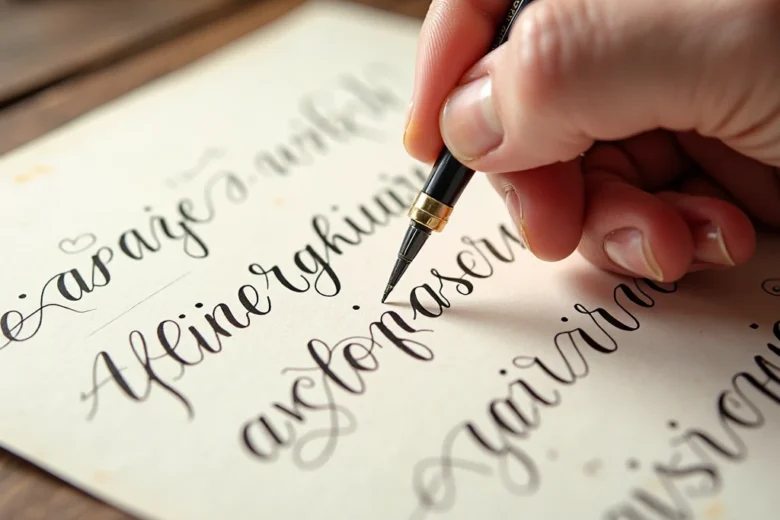
Learning how to write the alphabet in cursive was one of the best decisions I ever made. It’s not only a beautiful and expressive way to write but also improves your motor skills, hand-eye coordination, and even brain function. Whether you’re a beginner, a student, a parent, or just someone who wants to revisit an old skill, this guide will help you master cursive effortlessly.
Why Learn Cursive in the Digital Age?
With so many people typing on keyboards these days, you might wonder if cursive writing still matters. It does — and here’s why:
- Boosts Brain Development: Studies show that learning cursive activates more areas of the brain compared to typing.
- Enhances Fine Motor Skills: Practicing cursive letters improves hand-eye coordination.
- Encourages Artistic Expression: Cursive writing has a natural, flowing aesthetic that’s hard to match.
- Useful for Signatures: Every adult needs a signature — and learning cursive gives yours flair and consistency.
Step-by-Step Guide: How to Write the Alphabet in Cursive
Learning how to write the alphabet in cursive is a rewarding skill that combines creativity, muscle memory, and style. This easy-to-follow guide will walk you through every letter in the cursive alphabet, both lowercase and uppercase, and help you write smoothly and beautifully. Whether you’re just starting out or refreshing your skills, follow these steps to master the cursive alphabet.
Before You Begin: What You’ll Need
Before learning how to write the alphabet in cursive, gather these basic tools:
- Lined paper (preferably dotted midline or cursive practice sheets)
- Comfortable pen or pencil with a smooth grip
- A quiet space to focus and practice
- 15–20 minutes daily for consistent practice
Step 1: Learn Basic Strokes
Cursive writing involves several foundational shapes that form all letters. These include:
1. The Upward Stroke (or “Entry Stroke”)
- Start at the baseline (bottom line).
- Gently curve upward to the top line.
- This stroke begins letters like a, c, d, g, o, and q.
2. The Downward Stroke (or “Main Stroke”)
- Begin at the top line.
- Pull the pen downward to the baseline.
- Used in letters like l, t, i, and h.
3. The Overcurve (or “Connecting Stroke”)
- A small half-circle that connects letters.
- Keeps writing fluid without lifting the pen.
- Found in combinations like an, un, and ou.
4. The Undercurve (or “Exit Stroke”)
- A slight upward flick at the end of a letter.
- Prepares the pen to link to the next letter.
- Common in letters like e, m, n, and r.
5. Loops (Upper and Lower)
- Upper loops (for letters like b, f, h, k, l)
-
Start at the baseline, swing up past the top line, then curve down.
-
- Lower loops (for letters like g, j, y, z)
-
-
Begin at the baseline, drop below the line, then loop back up.
-
6. Compound Curves (for Letters Like s and r)
- A mix of upward and downward curves in one motion.
- Helps maintain consistent slant and flow.
Step 2: Master Lowercase Cursive Letters (a–z)
Start with lowercase letters, as they are used more often and are easier for beginners.
Group 1: The Basic Curve Letters (a, c, d, g, o, q)
These letters start with a small upward curve.
-
Letter “a”
-
Start with a tiny upward curve to the right.
-
Loop down and around to form an oval.
-
Finish with a small tail to connect to the next letter.
-
-
Letter “c”
-
Begin with a small curve upward.
-
Draw a backward half-circle.
-
End with a slight upward flick for linking.
-
Pro Tip: Keep the oval shape rounded—not too narrow or wide.
Group 2: The Looped Letters (b, f, h, k, l)
These letters have tall upward loops.
-
Letter “l”
-
Start at the baseline, swoop upward in a tall loop.
-
Curve back down smoothly.
-
Add a small connecting stroke at the bottom.
-
-
Letter “f”
-
Make a tall upward loop, then curve downward.
-
Cross near the top with a short horizontal line.
-
Common Mistake: Avoid making loops too thin or shaky—keep them confident and even.
Group 3: The U-Shaped Letters (m, n, v, w, x, y, z)
These letters rely on smooth humps and angles.
1. Letter “m”
- Start with a small upward curve.
- Draw two rounded humps (like rolling hills).
- Finish with a connecting stroke.
2. Letter “z”
- Begin with a small loop.
- Draw a diagonal line down, then a sharp horizontal dash.
- End with a small upward flick.
Key Rule: Keep consistent spacing between humps.
Group 4: The Unique Letters (e, i, j, p, r, s, t, u)
These have slight variations.
-
Letter “e”
-
Start with a small upward curve.
-
Create a tight loop (like a small “c”).
-
Finish with a connecting stroke.
-
-
Letter “t”
-
Begin with a short upward stroke.
-
Cross near the top with a quick horizontal line.
-
Pro Tip: For letter “i” and “j”, dot them after finishing the word to avoid smudging.
Step 3: Learn Uppercase Cursive Letters (A–Z)
Mastering uppercase cursive letters is key to writing names, titles, and formal documents beautifully. Unlike lowercase letters, uppercase cursive letters often have more flourishes and unique strokes. Follow this step-by-step guide to learn how to write the alphabet in cursive with confidence.
Before You Start: Helpful Tips
- Use lined paper to keep letters uniform in size.
- Practice basic strokes first (loops, curves, and slants).
- Go slow—focus on precision, not speed.
- Trace examples before writing freehand.
How to Write Uppercase Cursive Letters (A–Z)
Group 1: Letters with Big Loops (B, D, F, L, P, T)
These letters start with a bold upward stroke and often include a large loop.
- B: Start with a tall upward stroke, loop to the right, then curve down and add a small half-loop.
- D: Begin with a tall upward stroke, then create a backward loop before curving down.
- F: Make a tall upward stroke, loop to the right, then cross with a horizontal line near the top.
- L: Start with a tall upward curve, then loop down to the right in a smooth motion.
- P: Begin with a tall upward stroke, loop to the right, then curve down and finish with a small upward flick.
- T: Start with a downward stroke, then cross near the top with a horizontal line.
Group 2: Letters with Curves and Swirls (A, C, E, G, O, Q)
These letters rely on smooth, rounded shapes.
- A: Start with a small downward curve, then form a rounded shape with a slight upward flick.
- C: Begin with a small curve inward, then create a large backward half-circle.
- E: Start with a small loop, then form a backward curve with a horizontal line in the middle.
- G: Make a large backward loop, then add a small tail curling upward.
- O: Form a full, smooth oval shape without lifting your pen.
- Q: Similar to “O,” but end with a small downward tail.
Group 3: Letters with Sharp Angles (H, K, M, N, V, W, X, Y, Z)
These letters include sharp turns and diagonal lines.
- H: Start with a tall upward stroke, then make a sharp downward curve with a small loop at the bottom.
- K: Begin with a tall upward stroke, then form a diagonal line with a small loop.
- M: Create two high peaks with smooth downward strokes.
- N: Form one high peak followed by a diagonal downward stroke.
- V: Make a sharp downward stroke, then curve upward diagonally.
- W: Similar to “V,” but with two peaks instead of one.
- X: Draw two diagonal crossing lines with a slight curve.
- Y: Start with a downward stroke, then curve into a small loop.
- Z: Begin with a horizontal stroke, then form a diagonal downward line with a small tail.
Group 4: Unique Letters (I, J, R, S, U)
These letters have distinctive shapes that set them apart.
- I: Start with a small upward curve, then make a straight downward line with a dot at the top.
- J: Begin with a downward stroke, then add a small loop at the bottom.
- R: Similar to “P,” but end with a small upward flick instead of a full loop.
- S: Start with a small curve inward, then form a smooth backward “C” shape.
- U: Make a downward curve, then loop upward in a smooth motion.
Step 4: Practice Letter Connections
Cursive letters flow into one another. Here’s how to practice connections:
1. Basic Connecting Strokes
Most cursive letters connect with a small upward or downward flick:
- Letters ending at the baseline (like a, c, d) connect with a small upward stroke.
- Letters ending below the baseline (like g, j, y) use a slight upward curve to link to the next letter.
Practice these fundamental strokes first before moving to full words.
2. Connecting Lowercase Letters
Start with simple two-letter combinations:
- at, an, am – Notice how the t, n, and m naturally flow from the first letter.
- it, in, is – The i connects smoothly to tall letters.
- be, by, but – The b leads into other letters with an upward curve.
Progression:
- Write each pair 5 times slowly.
- Gradually increase speed while keeping connections neat and clear.
3. Connecting Uppercase to Lowercase Letters
Uppercase letters connect differently:
- Most uppercase letters (like A, C, E) end with a small lead-in stroke to link to the next lowercase letter.
- Some uppercase letters (like B, D, F) require you to retrace slightly before connecting.
Practice these combinations:
- Al, An, At – Focus on the transition from the capital to the small letter.
- Be, By, Br – Notice how the B connects with a slight curve.
Step 5: Form Full Sentences in Cursive
Now that you’ve mastered individual letters and connections, it’s time to learn how to write the alphabet in cursive by forming complete sentences. This final step will help you develop fluent, beautiful cursive handwriting for everyday use.
Before You Begin: Essential Tips
- Use wide-ruled paper for better spacing
- Maintain a consistent slant (about 45 degrees)
- Keep your grip relaxed to prevent hand fatigue
- Practice with a smooth-writing pen for best results
How to Write Complete Sentences in Cursive
-
Start with Short, Simple Sentences
Begin with basic 3-5 word sentences like:
- The cat ran fast.
- I love to write.
- She has a pen.
-
Focus on Three Key Elements:
-
Letter connections: Ensure each word flows without breaks
-
Word spacing: Leave about one letter space between words
-
Consistency: Keep all letters the same size and slant
-
-
Practice Common Letter Combinations
Work on frequently used connections:
- th (as in “the”)
- ch (as in “chair”)
- sh (as in “she”)
- wh (as in “when”)
-
Gradually Increase Sentence Length
Progress to longer sentences:
- The quick brown fox jumps over the lazy dog.
- Pack my box with five dozen liquor jugs.
- How vexingly quick daft zebras jump!
Step 6: Daily Cursive Practice Routine
Here’s a simple routine to master how to write the alphabet in cursive:
Daily Practice Plan:
| Day | Focus | Time |
|---|---|---|
| Day 1 | Lowercase a–f | 15 minutes |
| Day 2 | Lowercase g–l | 15 minutes |
| Day 3 | Lowercase m–r | 15 minutes |
| Day 4 | Lowercase s–z | 15 minutes |
| Day 5 | Uppercase A–G | 20 minutes |
| Day 6 | Uppercase H–N | 20 minutes |
| Day 7 | Uppercase O–Z | 20 minutes |
| Day 8+ | Word and sentence practice | 20 minutes daily |
Consistency is key. Practicing even 10 minutes daily will show major improvement in a few weeks.
Step 7: Customize and Refine Your Style
Once you know how to write the alphabet in cursive, develop your personal flair:
1. Analyze Your Current Handwriting
Before making changes, examine your cursive:
- Write a sample paragraph (e.g., a favorite quote or short passage).
- Identify strengths (smooth connections, consistent slant).
- Note areas for improvement (letter shapes, spacing, slant consistency).
2. Adjust Letter Shapes for Personality
Small tweaks can make your cursive distinct and elegant:
- Loops: Experiment with larger or smaller loops in letters like l, b, f, g.
- Tail length: Try longer or shorter tails on y, g, j.
- Connections: Modify how letters link—smoother curves or sharper angles.
Try this: Rewrite the alphabet with one stylistic change (e.g., wider loops) and see how it feels.
3. Improve Consistency
Uniformity makes cursive cleaner and more professional:
- Slant: Use guideline paper to keep letters at the same angle (typically 45°).
- Size: Ensure lowercase letters are half the height of uppercase letters.
- Spacing: Leave even gaps between words (about the width of a lowercase *o*).
4. Speed vs. Legibility Balance
- For notes/signatures: Slightly faster writing with acceptable shortcuts (e.g., simplified *z* or *r*).
- For formal writing: Slow down for neater, more precise letters.
Practice tip: Time yourself writing a sentence neatly, then gradually increase speed while maintaining clarity.
5. Refine Your Signature
Your signature is the ultimate personalized cursive:
- Experiment with flourishes (e.g., underline, extended first/last letter).
- Keep it repeatable—practice until you can write it the same way every time.
- Test different pens to find what feels smoothest.
Common Mistakes (and How to Fix Them)
Learning how to write the alphabet in cursive takes practice, and even experienced writers make mistakes. Here are the most common cursive errors—and simple ways to correct them for cleaner, more elegant handwriting.
1. Inconsistent Letter Slant
Problem: Letters tilt at different angles, making writing look messy.
Fix:
- Use slanted guideline paper (around 45 degrees).
- Rotate your paper slightly to match your natural hand movement.
- Practice with basic strokes (////) to build muscle memory.
2. Broken Connections Between Letters
Problem: Gaps between letters disrupt the flow of cursive.
Fix:
- Focus on keeping your pen on the paper between letters.
- Practice common letter pairs (like “th,” “ch,” “ou”).
- Slow down and exaggerate connections at first.
3. Letters Too Big or Too Small
Problem: Inconsistent sizing makes words hard to read.
Fix:
-
Follow the “two-line rule”:
-
Lowercase letters = half the height of uppercase.
-
Tall letters (b, d, h, k, l, t) = reach the top line.
-
Low letters (g, j, p, q, y) = extend below the baseline.
-
-
Use lined paper to train consistency.
4. Poor Spacing Between Words
Problem: Words either run together or are too far apart.
Fix:
- Leave one lowercase “o” width between words.
- Mark spacing with a light pencil dot until it feels natural.
5. Shaky or Uneven Lines
Problem: Wobbly strokes make writing look unpolished.
Fix:
- Rest your hand lightly—no death grip on the pen.
- Move your whole arm slightly, not just your fingers.
- Try a weighted pen or thicker grip for better control.
6. Overly Tight or Loose Loops
Problem: Loops in letters (like l, e, f, g) look squished or too open.
Fix:
- Practice oval shapes separately to train even loops.
- For tight loops, slow down and relax your grip.
- For loose loops, focus on controlled, smaller motions.
7. Mixing Print and Cursive
Problem: Some letters revert to print (like “s” or “z”).
Fix:
- Isolate problem letters and rewrite them 10 times daily.
- Use a cursive reference sheet until muscle memory kicks in.
8. Hand Fatigue
Problem: Hand cramps make practice uncomfortable.
Fix:
- Stretch fingers before and after writing.
- Use a comfort-grip pen or ergonomic pencil.
- Limit sessions to 15-20 minutes with breaks.
Quick Reference: Fixes at a Glance
| Mistake | Solution |
|---|---|
| Uneven slant | Use slanted guidelines |
| Gaps in words | Keep pen on paper |
| Inconsistent size | Follow the two-line rule |
| Bad spacing | Leave an “o” width |
| Shaky lines | Loosen grip, use arm motion |
| Loop problems | Practice oval drills |
| Print habits | Focus on cursive-only drills |
| Hand cramps | Stretch, use ergonomic tools |
FAQs About How to Write the Alphabet in Cursive
1. How long does it take to learn cursive writing?
With consistent practice (10-15 minutes daily), most people see noticeable improvement in 2-4 weeks. Full mastery typically takes 2-3 months.
2. What’s the best pen for cursive writing?
A smooth gel pen or fountain pen works best for cursive. Avoid ballpoints that require more pressure.
3. Should I learn lowercase or uppercase letters first?
Start with lowercase letters, as they’re used more frequently. Then progress to uppercase letters and connections.
4. How can I make my cursive more elegant?
- Focus on consistent slant and spacing
- Add slight flourishes to entry/exit strokes
- Practice writing at a 45-degree angle
5. Why does my cursive look messy?
Common causes include:
- Rushing (slow down for better control)
- Inconsistent letter sizes (use lined paper)
- Uneven pressure (use a lighter grip)
6. Is cursive faster than printing?
Yes, once mastered. Cursive is 25-50% faster because you:
- Lift the pen less
- Use continuous motions
- Develop muscle memory
7. How do I connect tricky letters like ‘b’, ‘o’, or ‘v’?
For difficult connections:
- Practice letter pairs (bo, ov, etc.)
- Exaggerate the connecting stroke at first
- Use dotted worksheets as guides
8. Can adults learn cursive effectively?
Absolutely. Adults often learn faster due to:
- Better fine motor control
- Stronger discipline for practice
- Clearer understanding of letter forms
9. How can I help my child learn cursive?
- Start with large letter tracing
- Use colored markers to make it fun
- Focus on correct grip and posture
- Keep sessions short (5-10 minutes)
10. Do schools still teach cursive writing?
Some do, but many don’t. However, cursive remains valuable for:
- Developing fine motor skills
- Reading historical documents
- Creating signatures
- Improving writing speed
11. How often should I practice cursive?
For best results:
- Daily practice (10-15 minutes)
- Focused sessions on problem areas
- Real-world application (shopping lists, notes)
12. What’s the hardest letter to write in cursive?
Most people struggle with:
- Uppercase F and Z (complex forms)
- Lowercase f and r (unusual connections)
- Consistent s and z (similar shapes)
13. Can I mix cursive and print writing?
While possible, it’s better to:
- Commit to full cursive for consistency
- Develop one fluid style
- Avoid hybrid habits that slow writing
14. How do I maintain good cursive posture?
- Sit upright with feet flat
- Rest forearm on the table
- Hold pen at 45 degrees
- Keep paper slanted (30-45 degrees)
15. Where can I find cursive practice sheets?
Many free resources exist:
- Education websites (printable PDFs)
- Handwriting workbooks
- Online generators (custom worksheets)
Final Thoughts
Mastering how to write the alphabet in cursive is a valuable skill that improves with consistent, mindful practice. Whether you’re learning for personal enjoyment, professional needs, or academic purposes, remember that progress comes from focusing on proper form, steady pacing, and regular repetition. Start with the basic strokes, build up to letter connections, and gradually work toward fluid sentences. Over time, your cursive will become more natural, legible, and uniquely yours.
To maintain your progress, incorporate cursive into daily tasks like journaling, note-taking, or signing documents. If you hit plateaus, revisit foundational techniques or try new practice methods to keep improving. With dedication, you’ll develop a clean, elegant cursive style that serves you well for years to come. For additional guidance, explore advanced cursive resources or seek feedback from experienced writers.