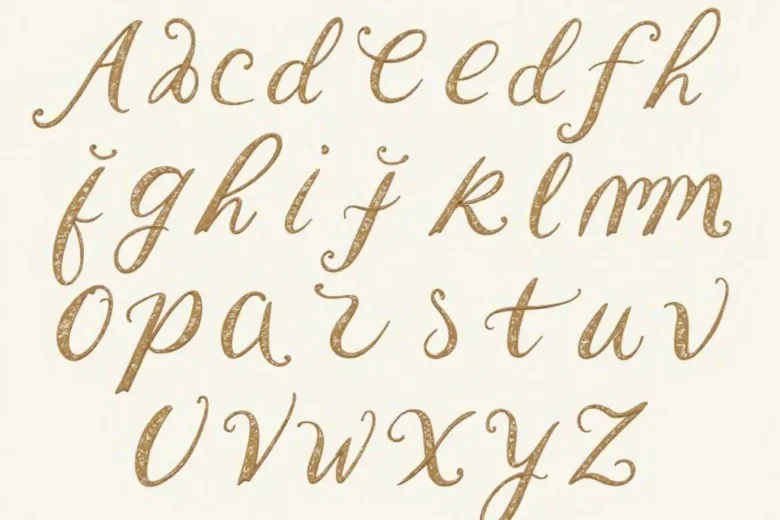
Welcome to the beautiful world of the Cursive Alphabet A to Z—where every curve and flourish brings elegance to your writing. Whether you’re a beginner or looking to refine your skills, mastering cursive can boost creativity, improve handwriting speed, and even enhance memory.
Why Learn the Cursive Alphabet A to Z?
Learning the Cursive Alphabet A to Z is more than just writing in a fancy style—it offers real benefits for students, professionals, and anyone who values clear, elegant handwriting. In this guide, we’ll explore why cursive remains important and how mastering it can improve your skills.
Key Benefits of Learning the Cursive Alphabet A to Z
1. Improves Handwriting Speed & Efficiency
- Cursive connects letters, allowing faster writing than print.
- Helps with note-taking in school or meetings.
- Reduces hand fatigue since the pen stays on the paper longer.
2. Enhances Brain Development
- Research shows cursive activates different parts of the brain than typing or print writing.
- Strengthens memory retention by engaging motor skills.
- Helps with reading comprehension, especially historical documents.
3. Boosts Fine Motor Skills
- The flowing movements improve hand control and coordination.
- Great for young learners developing writing skills.
- Helps individuals with dysgraphia or handwriting difficulties.
4. Adds a Personal & Professional Touch
- Signatures are often in cursive—mastering it makes yours stand out.
- Useful for formal invitations, certificates, and letters.
- Gives a classic, elegant look to handwritten notes.
5. Preserves a Valuable Skill
- Many historical documents are written in cursive.
- Helps in reading old letters, diaries, and legal papers.
- Keeps the art of handwriting alive in a digital world.
How to Start Learning the Cursive Alphabet A to Z
Step 1: Master Basic Strokes
- Practice upward and downward curves before full letters.
- Work on consistent slant (most cursive leans slightly to the right).
Step 2: Learn Lowercase Letters First
- Start with simple letters like a, c, e.
- Move to taller letters like b, d, f.
- Finish with tricky loops like g, q, z.
Step 3: Practice Uppercase Letters
- Some, like A, C, O, are similar to print but with flourishes.
- Others, like G, Q, S, have unique shapes—take extra time.
Step 4: Connect Letters into Words
- Begin with short, common words (e.g., “and,” “the,” “you”).
- Gradually write longer sentences.
Step 5: Build Consistency
- Use lined paper to keep letters uniform.
- Slow down at first—speed will come naturally.
- Practice daily for best results.
Breaking Down the Cursive Alphabet A to Z
Mastering the Cursive Alphabet A to Z requires understanding each letter’s unique shape and flow. This guide breaks down every letter with clear instructions to help you develop beautiful, consistent cursive handwriting.
Understanding Cursive Letter Structure
Before diving into individual letters, it’s important to know that cursive writing has three main components:
- Entry Strokes – The starting point of each letter
- Main Body – The primary shape of the letter
- Exit Strokes – The connecting line to the next letter
Most cursive letters follow a rightward slant (about 35-45 degrees) for uniformity.
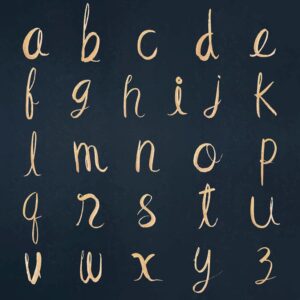
Lowercase Cursive Alphabet A to Z
Basic Oval Letters (a, c, d, e, g, o, q)
- Start with a small upward curve from the baseline
- Form a rounded shape (like an oval)
- For g, q, y, add a descending tail below the line
Practice Tip: Keep ovals evenly sized – these form the foundation of many letters.
Loop Letters (b, f, h, k, l)
- Begin with an upward stroke reaching the top line
- Curve downward, forming a loop
- f is unique – it crosses below the baseline
Pointed Top Letters (i, j, m, n, p, r, s, u, v, w, x, y, z)
- Start with a slight upward curve
- Create peaks at the top (for m, n, v, w)
- z has a sharp diagonal stroke
Special Case Letters
- s – Often tricky; practice its wave-like shape
- r – Stops halfway down before curving up
- t – Cross after completing the word
You May Also Like: How to write the alphabet in cursive
Uppercase Cursive Alphabet A to Z
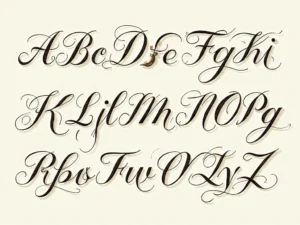
Basic Capital Letters (A, C, E, O)
- Similar to print but with more flourishes
- Start with a downward stroke, then curve
Looped Capitals (B, D, F, G, H, K, L, P, Q, S, T, Y, Z)
- Feature decorative loops and swirls
- Q looks like a fancy “2”
- Z has a dramatic center cross
Unique Capitals (I, J, M, N, R, U, V, W, X)
- I and J have elaborate tops
- M and W feature multiple peaks
- X crosses in the center
Connecting Letters: Cursive Writing in Action
-
Basic Connections
-
Most letters connect at the baseline
-
Some (like b, o, v, w) connect at the top
-
-
Troublesome Combinations
-
o followed by r, v, w – requires lifting the pen slightly
-
s connections – needs smooth exit strokes
-
-
Practice Words
-
Start with: “and,” “the,” “that”
-
Progress to: “quick,” “jumps,” “fox”
-
How to Practice the Cursive Alphabet A to Z Perfectly
Phase 1: Master Individual Letters
-
Start with Lowercase Letters
-
Group similar letters together for efficient practice:
-
Basic letters: a, c, e, i, m, n, o, r, s, u, v, w, x
-
Tall letters: b, d, f, h, k, l, t
-
Descending letters: g, j, p, q, y, z
-
-
-
Practice Uppercase Letters
-
Begin with simpler capitals: A, C, E, I, J, K, L, M, N, O, P, S, T, U, V, W, X, Y, Z
-
Progress to complex capitals: B, D, F, G, H, Q, R
-
-
Perfect Each Letter
-
Write each letter 10-15 times
-
Focus on:
-
Correct formation
-
Consistent size
-
Proper slant
-
-
Phase 2: Connect Letters into Words
-
Start with Simple Letter Pairs
-
Practice common combinations:
-
“th”, “ch”, “sh”, “wh”
-
“ou”, “an”, “in”, “er”
-
-
-
Progress to Full Words
-
Begin with 3-letter words: and, the, you, can
-
Advance to longer words: quick, brown, jumps
-
-
Write Short Sentences
-
Example: “The quick brown fox jumps.”
-
Focus on smooth connections between letters
-
Phase 3: Build Speed While Maintaining Quality
-
Use Timed Practice Sessions
-
Start with slow, deliberate writing
-
Gradually increase speed while keeping letters clear
-
-
Practice Common Phrases
-
“Sincerely yours,”
-
“Thank you very much,”
-
“With best regards,”
-
-
Copy Paragraphs
-
Transcribe short passages from books
-
Maintain consistent letter size and spacing
-
Proven Practice Techniques
-
Tracing Method
-
Use printed guides or tracing paper
-
Helps develop muscle memory
-
-
Air Writing
-
Practice letter shapes in the air
-
Strengthens arm movements
-
-
Mirror Writing
-
Write letters backwards
-
Improves letter recognition
-
-
Alternate Hands
-
Try writing with your non-dominant hand
-
Enhances brain-hand coordination
-
Common Mistakes & How to Fix Them
Learning the Cursive Alphabet A to Z can be challenging, and many beginners make similar mistakes. Identifying and correcting these errors early will help you develop clean, consistent cursive handwriting. Below are the most common cursive writing mistakes and practical solutions to fix them.
1. Inconsistent Letter Slant
Problem: Letters lean in different directions, making writing look messy.
Solution:
- Use angled guideline paper (45-degree slant)
- Practice drawing parallel diagonal lines before writing
- Keep your paper tilted to match your natural arm movement
2. Uneven Letter Sizes
Problem: Some letters are too big or small compared to others.
Solution:
- Use three-lined paper (top, middle, and baseline)
- Pay attention to letter height groups:
-
Short letters (a, c, e, m, n, o, r, s, u, v, w, x, z)
-
Tall letters (b, d, f, h, k, l, t)
-
Descending letters (g, j, p, q, y)
-
3. Poor Letter Connections
Problem: Gaps between letters or awkward joins.
Solution:
- Practice exit and entry strokes separately
- Focus on troublesome letter pairs (e.g., “o” followed by “r” or “v”)
- Write slowly at first, ensuring each letter connects smoothly
4. Incorrect Letter Forms
Problem: Letters don’t match standard cursive shapes (e.g., “s” looking like a print letter).
Solution:
- Study proper cursive letter charts
- Use tracing worksheets to reinforce correct shapes
- Compare your letters to model examples and adjust
5. Hand Fatigue & Tension
Problem: Hand cramps or shaky lines due to tight grip.
Solution:
- Hold the pen lightly (no white knuckles)
- Use larger arm movements instead of just finger motions
- Take short breaks every 10-15 minutes
6. Writing Too Fast
Problem: Sloppy, illegible cursive from rushing.
Solution:
- Start slowly, focusing on precision over speed
- Gradually increase speed only after letters are consistent
- Use a metronome to pace yourself
7. Skipping Basic Strokes
Problem: Jumping straight into letters without mastering foundational strokes.
Solution:
-
Dedicate 5 minutes per session to basic drills:
- Upstrokes (light pressure)
- Downstrokes (firm pressure)
- Loops and curves
8. Ignoring Spacing
Problem: Words look cramped or too spread out.
Solution:
- Use the “little finger spacing” rule (leave a pinky-width between words)
- Practice writing evenly spaced sentences
9. Inconsistent Pressure
Problem: Some lines are too faint or dark.
Solution:
- Use a flexible nib pen to practice pressure control
- Focus on light upstrokes and firm downstrokes
10. Not Reviewing Progress
Problem: Repeating mistakes without improvement.
Solution:
- Keep a dated handwriting journal
- Compare samples weekly to track progress
- Focus on one correction at a time
Fun Ways to Master Cursive Writing
Cursive Alphabet A to Z doesn’t have to be dull. By incorporating creative and engaging methods, you can improve your cursive writing while enjoying the process. Here are effective and enjoyable techniques to help you master cursive with ease.
1. Turn Practice into a Game
- Letter Challenges: Time yourself to write the full Cursive Alphabet A to Z in under a minute (with accuracy).
- Word Races: Compete with a friend to see who can write a sentence neatly and quickly.
- Cursive Bingo: Create bingo cards with different cursive letters or words.
2. Creative Writing Exercises
- Write Secret Messages: Use cursive to create coded notes for friends or family.
- Keep a Cursive Journal: Write daily thoughts, quotes, or short stories in cursive.
- Compose Letters or Postcards: Send handwritten notes to loved ones for extra practice.
3. Artistic Cursive Projects
- Design Name Art: Write your name in decorative cursive and embellish it with swirls.
- Create Cursive Posters: Practice by writing motivational quotes in large, stylish cursive.
- Trace Over Designs: Print fancy fonts and trace over them to improve flow.
4. Use Technology for Practice
- Try Cursive Apps: Some apps offer interactive cursive lessons with instant feedback.
- Digital Stylus Practice: Use a tablet and stylus to write cursive on note-taking apps.
- Watch Tutorial Videos: Follow along with guided cursive writing videos.
5. Make It Musical
- Write Song Lyrics: Copy your favorite songs in cursive to practice rhythm and flow.
- Cursive to a Beat: Write letters in time with slow-tempo music for consistent pacing.
6. Everyday Cursive Integration
- Grocery Lists: Write shopping lists in cursive.
- To-Do Notes: Use cursive for daily reminders.
- Label Items: Practice by labeling jars, notebooks, or folders.
7. Group Activities
- Cursive Study Group: Meet with friends to practice together.
- Pen Pal Exchange: Find a pen pal and write letters in cursive.
- Classroom Competitions: If in school, challenge classmates to cursive contests.
8. Reward-Based Learning
- Set Milestones: Reward yourself after mastering a set of letters.
- Progress Chart: Track improvements with stickers or checkmarks.
FAQs About the Cursive Alphabet A to Z
1. Why is learning the Cursive Alphabet A to Z important?
Learning cursive improves handwriting speed, enhances fine motor skills, and helps with cognitive development. It also allows you to read historical documents and write elegant signatures.
2. At what age should someone start learning cursive?
Children can begin around age 7 or 8, once they have mastered print letters. However, any age can learn cursive with proper practice.
3. How long does it take to learn the Cursive Alphabet A to Z?
With daily practice, most people see noticeable improvement in 4-6 weeks. Mastery may take several months depending on consistency.
4. What’s the best way to practice cursive writing?
- Start with basic strokes
- Practice individual letters before connecting them
- Use guided worksheets for consistency
- Write short words and sentences
5. Should I learn uppercase or lowercase cursive letters first?
Begin with lowercase letters, as they are used more frequently. Once comfortable, move to uppercase letters.
6. What are the hardest letters in the Cursive Alphabet A to Z?
Many find uppercase G, Q, and Z challenging due to their unique shapes. In lowercase, f, r, and s often require extra practice.
7. How can I fix messy or uneven cursive writing?
- Slow down and focus on each stroke
- Use lined paper for consistent sizing
- Practice letter connections separately
8. Is cursive writing still taught in schools?
Some schools still teach cursive, while others have reduced emphasis. However, it remains a valuable skill worth learning independently.
9. Can cursive help with typing or digital communication?
While cursive is a handwriting skill, it improves hand-eye coordination and fine motor control, which can benefit overall dexterity.
10. How can I make my cursive writing more elegant?
- Maintain a consistent slant
- Use smooth, flowing strokes
- Practice letter flourishes for style
11. Do left-handed people struggle with cursive?
Left-handed writers may need to adjust paper angle and hand position, but they can write cursive just as neatly with practice.
12. What tools are best for cursive practice?
- Pencils for beginners (easier control)
- Fountain pens for advanced learners (better ink flow)
- Lined or dotted paper for alignment
13. How often should I practice cursive?
10-15 minutes daily is more effective than occasional long sessions. Consistency matters more than duration.
14. Can learning cursive improve my print handwriting?
Yes, cursive practice enhances letter formation and spacing, which often improves print writing as well.
15. Where can I find resources to learn the Cursive Alphabet A to Z?
- Printable worksheets online
- Handwriting workbooks
- Online tutorials with stroke guides
Final Thoughts: Keep Practicing!
Mastering the Cursive Alphabet A to Z is a journey that rewards patience and consistent effort. While it may feel challenging at first, regular practice will help develop muscle memory, leading to smooth, elegant handwriting. Remember that progress comes gradually—focus on proper letter forms and connections before worrying about speed. Whether you’re learning for academic purposes, professional use, or personal enjoyment, cursive remains a valuable skill that enhances both communication and cognitive abilities.
Keep your practice sessions short but frequent, aiming for 10-15 minutes daily rather than occasional long drills. Use guided worksheets to maintain consistency, and don’t hesitate to revisit basic strokes if needed. Over time, you’ll notice your Cursive Alphabet A to Z becoming more fluid and natural. The key is to stay persistent—every great cursive writer started exactly where you are now. With dedication, you’ll develop handwriting that’s both functional and beautiful, a skill that will serve you for years to come.